
Import and Export in the UAE - Import and Export in the UAE Guide

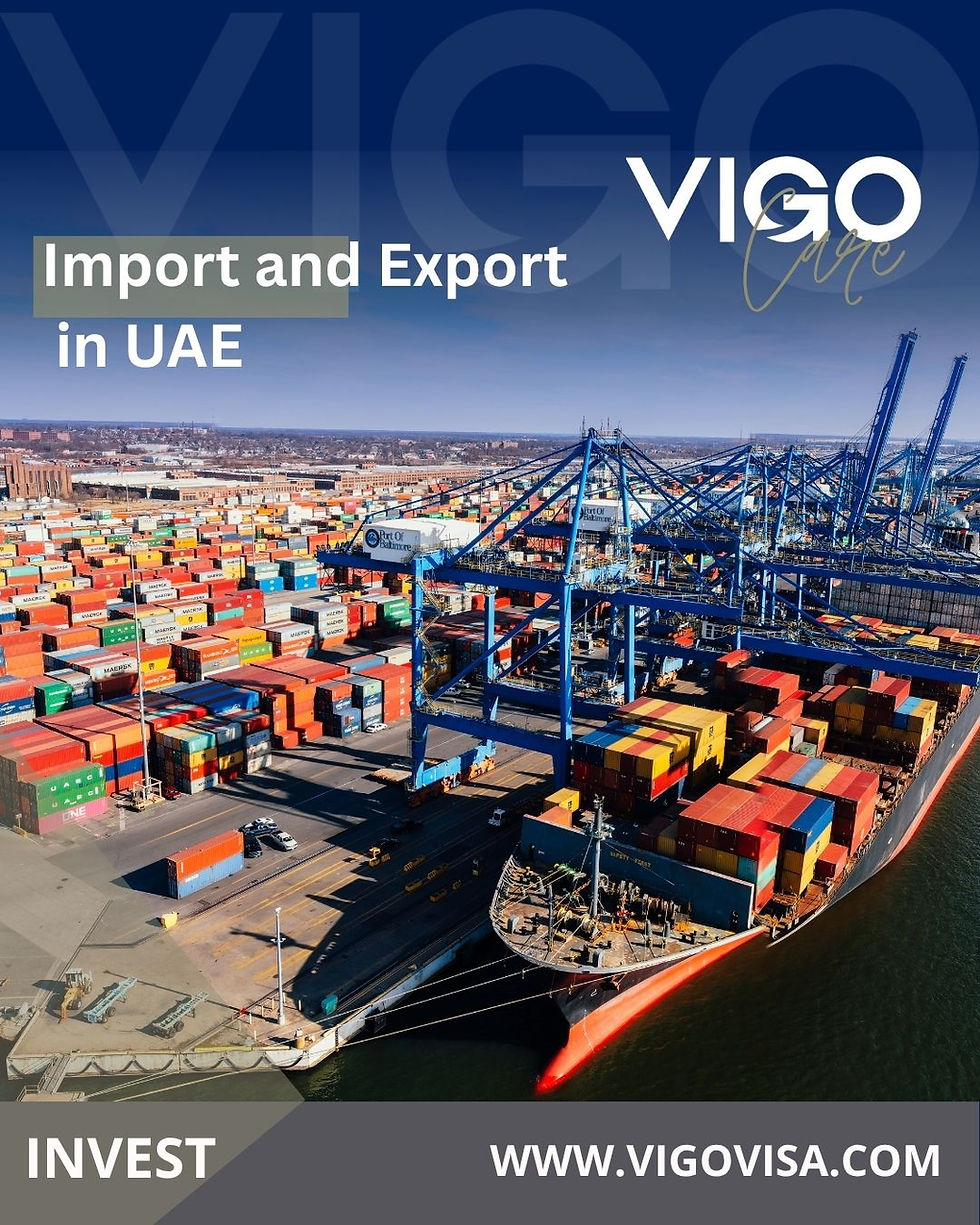
Import and Export in the UAE - Import and Export in the UAE Guide
Import and Export in the UAE : The Complete Guide for Importers, Exporters and International Businesses
Import and Export in the UAE: The Direct Answer and Executive Overview
Importing and exporting in the UAE in 2026 offers businesses access to one of the world’s most internationally connected trade and logistics hubs. The UAE combines major seaports and airports, modern customs systems, specialized free zones, extensive logistics infrastructure and a strategic location connecting Asia, Europe, Africa and the wider Middle East. Import and Export in the UAE - Import and Export in the UAE Guide
Businesses can import goods into the UAE for local sale, use the country as a distribution center, operate from mainland or appropriate free-zone structures, and re-export products to international markets.
However, successful international trade requires much more than obtaining a trading license and purchasing products from an overseas supplier.
For imports, the correct commercial sequence is:
Product → Business Activity → HS Code → Import Eligibility → Regulatory Authority → Product Compliance → Supplier Verification → Landed Cost → Shipping → Customs Clearance → Distribution.
For exports:
Product → Target Market → Destination Requirements → Pricing → Buyer → Export Documents → Customs → Shipping → Payment Collection.
And for re-export:
International Supplier → UAE Entry → Storage/Processing Where Applicable → Re-Export Documentation → Destination Market.
The most important rule is simple:
Never purchase a commercial shipment before confirming that the product can legally enter the UAE, identifying its correct customs classification, calculating the complete landed cost and verifying all product-specific requirements.
The UAE operates a federal customs framework while customs procedures are administered through the competent customs authorities in the individual emirates.
Depending on where goods enter or leave the country, businesses may interact with authorities such as Dubai Customs, Abu Dhabi Customs or the relevant customs administration in another emirate.
Products may also fall under specialized federal or local regulatory authorities depending on their category.
Trade Element | What the Business Should Understand |
Business structure | Mainland and suitable free-zone structures can support international trade |
Customs | Procedures depend on the relevant customs authority and port |
Product classification | Correct HS classification is essential |
Customs duty | Depends on classification, origin and applicable customs treatment |
VAT | Standard UAE VAT rate is 5% |
Import documents | Commonly include commercial invoice, transport documents and origin information |
Regulated products | Can require permits, registrations or conformity approvals |
Free zones | Important for international trade, warehousing and re-export |
Re-export | Major component of the UAE trading ecosystem |
Main ports | Jebel Ali and other UAE ports provide international connectivity |
Air cargo | Dubai and Abu Dhabi are major international aviation hubs |
Main principle | Calculate compliance and landed cost before purchasing |
The UAE’s trade infrastructure can make international commerce relatively efficient, but efficiency does not remove commercial risk.
A profitable import-export company still needs the correct products, reliable suppliers, competitive logistics, disciplined working-capital management and customers willing to buy at a sufficient margin.
How the UAE Import, Export and Re-Export System Works
The UAE’s geographic position has helped it develop into an important international trading center.
Goods arrive from manufacturing markets in Asia, Europe, the Americas, Africa and the Middle East and may be sold domestically, stored in logistics facilities or re-exported to another country.
This creates three distinct business models.
Importing means bringing foreign goods into the UAE.
Exporting generally means sending goods from the UAE to another country.
Re-exporting involves bringing foreign-origin goods into the UAE and subsequently exporting them to another market, subject to the applicable customs and trade rules.
The distinction matters because the customs, tax, documentation and commercial treatment may differ.
A company importing furniture from China for sale to customers in Dubai operates differently from a company importing electronics into a free-zone warehouse and later re-exporting them to Africa.
Likewise, a UAE manufacturer exporting locally produced food products has different documentation and origin considerations from a pure re-export trader.
The UAE’s combination of mainland commercial jurisdictions and free zones creates significant flexibility for these models.
Free zones can be particularly relevant to international traders because some provide specialized logistics, warehousing, port, airport or commodity ecosystems.
However, the best jurisdiction depends on where goods will physically move and where customers are located.
A business should not choose a free zone simply because the license appears inexpensive.
It should ask:
Where will the goods enter?
Where will they be stored?
Will they be sold in the UAE or re-exported?
Who will be the importer of record?
What customs procedures apply?
Does the company need a warehouse?
What tax treatment applies?
Which banks are suitable for the transaction profile?
These questions should determine the structure.
Mainland Trading Companies
A mainland company can be suitable for businesses importing products primarily for sale within the UAE.
Depending on the business activity and emirate, the company can obtain the appropriate commercial or trading activity and then complete customs and product-related registrations.
The exact license should reflect the products being traded.
A company licensed for one category should not assume that it can automatically import every other category.
Free Zone Trading Companies
Free-zone companies can be particularly useful for international trading, logistics and re-export businesses.
Some UAE free zones are directly integrated with major ports, airports and logistics infrastructure.
This can create operational advantages for businesses that receive products from one country, store them temporarily and then redistribute them internationally.
But free-zone status should not be confused with unlimited freedom to sell products anywhere without additional procedures.
The movement of goods from a free zone into the UAE mainland can trigger customs, VAT and other requirements.
The operating model must therefore be mapped before incorporation.
The Role of Customs
Customs authorities verify goods entering and leaving the UAE according to the applicable customs legislation and procedures.
The customs declaration identifies information such as:
the importer or exporter, goods, value, quantity, origin, HS classification and transportation.
Customs may review documents, inspect goods or request additional information depending on the shipment and risk profile.
A customs broker can assist businesses with customs procedures.
However, the importer remains responsible for ensuring that the shipment itself is legally and commercially prepared.
A customs broker cannot convert prohibited goods into permitted goods or make a technically non-compliant product compliant simply through paperwork.
HS Codes
The Harmonized System Code, or HS Code, is one of the most important elements of international trade.
It classifies the product for customs purposes.
The classification can affect:
customs duty;
import restrictions;
product approvals;
certificates;
rules of origin;
trade statistics; and
customs treatment.
A common mistake is accepting the HS Code provided by an overseas supplier without verification.
The supplier may be using its own country’s classification, an incomplete code or a generic description.
The UAE importer should verify the classification applicable to the shipment.
An incorrect HS classification can create delays, additional duty assessments or compliance problems.
Importing Goods into the UAE: Requirements, Documents and Product Compliance
The import process should begin before the purchase order is issued.
The importer should first confirm that its company has the appropriate business activity.
It should then determine whether the product is permitted, restricted or subject to specialized regulation.
The next step is identifying the relevant HS classification and applicable customs treatment.
After that, the business should establish which product documents and approvals are required.
A practical import sequence is:
Commercial License → Customs Registration → Product Classification → Regulatory Check → Supplier Verification → Product Compliance → Purchase Order → Pre-Shipment Documents → Transportation → Customs Declaration → Clearance → Delivery.
The exact documentation depends on the product, origin, transportation method and customs authority.
Common commercial documents can include:
Document | Purpose |
Commercial Invoice | Identifies seller, buyer, goods, quantities and value |
Packing List | Describes packages, quantities, weights and dimensions |
Bill of Lading | Used for sea transportation |
Air Waybill | Used for air transportation |
Certificate of Origin | Identifies the origin of the goods where required |
Customs Declaration | Declares goods to the customs authority |
Import Permit | Required for certain regulated products |
Conformity Documents | Required for applicable product categories |
Insurance Certificate | Evidence of cargo insurance where applicable |
The exact documentation should always be confirmed for the specific shipment.
Product Compliance
A product being legally manufactured in another country does not automatically mean it can be imported into the UAE without additional compliance.
The UAE has technical, health, safety and labeling requirements for different product categories.
Depending on the goods, businesses may need to consider:
product conformity, labeling, safety standards, energy-efficiency requirements, telecommunications approvals, food registration, health requirements or other regulatory conditions.
This means the importer should identify the product regulator before production begins.
If the product requires a particular label, plug, technical specification, ingredient declaration or certification, discovering that requirement after the container arrives can be expensive.
The correct approach is:
Regulatory Review → Supplier Specification → Sample Approval → Production → Inspection → Shipping.
Not:
Purchase → Ship → Ask Customs What Is Needed.
Food Imports
Food is a specialized import category.
Businesses importing food should verify the requirements of the competent food-safety and municipal authorities in the relevant emirate, together with applicable federal requirements.
Important issues can include:
ingredients, product registration, manufacturing information, shelf life, health certificates, labeling, Arabic information and storage conditions.
Temperature-controlled goods also require suitable logistics.
A frozen or chilled product can be legally compliant but commercially unusable if the cold chain fails.
Cosmetics and Personal Care Products
Cosmetics can require product registration and compliance with ingredient, labeling and safety requirements before they are placed on the UAE market.
Importers should not assume that a cosmetic approved for sale in Europe, Asia or another GCC country is automatically registered for UAE sale.
The importer should confirm the relevant registration procedure before placing a large order.
Medical Products and Pharmaceuticals
Medicines and medical products operate under specialized regulatory frameworks.
Requirements can involve company licensing, product registration, manufacturer information, technical documentation and approvals from the competent health authority.
Businesses should establish the regulatory classification of the product before purchasing commercial quantities.
A supplier describing an item as a “wellness product” does not determine its legal classification in the UAE.
Electrical and Electronic Products
Electrical and electronic goods can be subject to technical, conformity, energy-efficiency or telecommunications requirements depending on the product.
The importer should confirm:
voltage, plugs, labeling, technical specifications, model numbers, applicable conformity requirements and any specialized approvals.
Products incorporating wireless or telecommunications functions may require additional consideration.
Vehicles and Automotive Products
Vehicles, spare parts, tires and related products can have technical and conformity requirements.
The business should verify whether the model or component meets UAE and GCC specifications before purchase.
Used vehicles can involve different requirements from new vehicles.
Branded Products
Importing branded products also creates intellectual-property considerations.
A product can be technically compliant but still create legal problems if the importer does not have appropriate rights to distribute the brand.
Businesses should verify:
supplier authorization, trademark ownership, territorial distribution rights and authenticity.
Counterfeit goods can create serious customs and legal consequences.
Supplier Verification, Shipping, Incoterms and the True Landed Cost
A low supplier quotation does not necessarily represent a profitable opportunity.
The importer must first determine whether the supplier is genuine and capable of delivering consistent commercial quality.
Supplier verification should examine:
legal company registration, factory location, production capability, certifications, export history, bank account and references.
For significant orders, third-party factory inspections can be valuable.
The importer should also request samples.
A sample allows the business to evaluate:
materials, dimensions, packaging, performance, labeling and customer acceptance.
For custom products, the buyer should create a written specification and approved reference sample.
This becomes the standard against which mass production is inspected.
One of the most common international-trade disputes occurs when:
the sample was excellent but mass production was different.
A purchase contract should therefore define specifications clearly.
Incoterms
International Commercial Terms, commonly called Incoterms, help define certain responsibilities, costs and risks between the buyer and seller.
Common terms include:
EXW, FCA, FOB, CFR, CIF, CPT, CIP, DAP and DDP.
The correct term depends on the shipment.
Importers should understand exactly where the seller’s responsibility ends and the buyer’s responsibility begins.
A quotation described as CIF does not mean every cost until final delivery is included.
Destination charges, customs clearance, duty, VAT, local transportation and other expenses can remain the buyer’s responsibility depending on the transaction.
Likewise, DDP may appear convenient, but the buyer should understand who is legally acting as importer and how taxes and customs documentation are handled.
The cheapest freight quote is therefore not necessarily the cheapest shipment.
Sea, Air and Road Freight
Method | Main Advantage | Typical Use |
Sea Freight | Lower cost for large volumes | Containers and bulky goods |
Air Freight | Speed | High-value or urgent goods |
Road Freight | Regional efficiency | GCC trade |
Courier | Convenience | Samples and small shipments |
Sea freight is often the preferred option for large imports.
For containerized shipping, companies may use FCL or LCL.
FCL generally means the importer uses the full container.
LCL allows multiple importers to share container space.
LCL can be attractive for smaller quantities, but consolidation and handling costs should be considered.
Jebel Ali and UAE Logistics
Dubai’s Jebel Ali ecosystem is one of the UAE’s major international logistics advantages.
Its port, free-zone and warehousing infrastructure supports import, export and re-export operations across a wide range of industries.
Other UAE ports and airports also provide important trade routes.
The best entry point depends on:
supplier location, customer location, product type, shipping line, warehouse and final destination.
A company based in one emirate should not automatically assume that the nearest port produces the lowest total logistics cost.
Calculating Landed Cost
The most important number for an importer is not factory price.
It is landed cost.
A complete calculation may include:
Factory Price + Packaging + Inspection + Inland Transport + Export Charges + International Freight + Insurance + Customs Duty + VAT Treatment + Product Compliance + Customs Brokerage + Port Charges + UAE Transportation + Warehousing + Financing + Damage Allowance.
Cost | Included? |
Product | |
Packaging | |
Inspection | |
Origin transportation | |
Export documentation | |
Freight | |
Insurance | |
Customs duty | |
VAT | |
Product registration | |
Conformity | |
Customs broker | |
Port/terminal charges | |
Local delivery | |
Warehousing | |
Financing | |
Damage/shrinkage |
Only after calculating this number can the importer begin analyzing product margin.
And even landed cost is not the final commercial cost.
A company selling online may still pay:
marketplace commissions, digital advertising, last-mile delivery, returns and payment-processing fees.
A retailer may pay:
rent, staff, utilities and inventory financing.
A distributor may give retailers significant margins.
The true equation is therefore:
Selling Price – Landed Cost – Cost of Selling – Operating Costs = Commercial Profitability.
Customs Duty, VAT, Free Zones, Re-Export and Trade Profitability
Customs duty should be calculated according to the actual classification and customs treatment of the goods.
A commonly referenced general UAE customs duty is 5% of the value of goods plus cost, freight and insurance, but this is not a universal rate for every product.
Some goods can receive different rates, exemptions or specialized treatment.
Businesses should therefore verify the actual tariff classification rather than insert 5% into every financial model automatically.
Certain products can face significantly different duty treatment.
Origin can also matter.
The UAE’s international trade agreements can affect tariff treatment for qualifying goods when applicable rules of origin are satisfied.
A product being shipped from a country does not necessarily mean it originates in that country for preferential customs purposes.
Rules of origin must be considered separately.
VAT on Imports
The standard UAE VAT rate is 5%.
Imports can create VAT obligations under the applicable rules.
However, import VAT should not automatically be treated as a permanent product cost for every VAT-registered business.
Eligible input VAT may potentially be recoverable subject to the applicable requirements.
This distinction can materially affect the financial model.
For example, assume an importer calculates:
Product + Freight + Customs Duty + VAT.
If the VAT is recoverable, treating it as a permanent margin cost can understate profitability.
At the same time, it may still create a cash-flow impact.
Accounting and cash-flow treatment should therefore be separated.
Free Zones and Customs
The UAE contains both free zones and designated zones for VAT purposes, and these concepts should not be treated as automatically identical.
Special customs arrangements can apply to goods stored or moved within relevant free-zone structures.
When goods move into the UAE mainland, customs and VAT consequences may arise.
This is one reason free zones can be attractive for re-export businesses.
Goods may be brought into a logistics ecosystem, stored and then sent to another international market according to the applicable rules.
But the exact treatment should be confirmed for the selected free zone and transaction.
Re-Exporting from the UAE
Re-export is an important UAE trading model.
A company can source goods internationally, use the UAE as a logistics or distribution hub and then ship those goods to customers in other countries.
This model can be attractive where the UAE offers:
central warehousing, efficient freight connections, regional banking, international business services and access to multiple destination markets.
But re-export profitability depends on volume and efficiency.
The trader should calculate:
Supplier Cost → UAE Logistics → Storage → Handling → Re-Export Documentation → International Freight → Distributor Margin → Payment Risk.
Adding an extra country to the supply chain only makes sense if the UAE hub creates sufficient value.
That value may come from:
consolidating multiple suppliers, splitting shipments, regional inventory, faster customer delivery, quality control, financing, packaging or market access.
Inventory Turnover
International traders should not focus only on margin percentage.
Inventory turnover can be equally important.
Consider two businesses.
Business A makes a 40% gross margin but turns its inventory once per year.
Business B makes a 15% margin but turns inventory six times per year.
Business B may generate a stronger return on working capital.
Key trading KPIs include:
KPI | Why It Matters |
Gross Margin | Profit before broader operating expenses |
Net Margin | Final profitability |
Inventory Turnover | How efficiently stock converts to sales |
Days Inventory | How long products remain in stock |
Landed Cost | True cost of imported goods |
Cash Conversion Cycle | Time between paying suppliers and collecting customers |
Defect Rate | Quality risk |
Return Rate | Customer/product quality indicator |
Freight Cost per Unit | Logistics efficiency |
Customs Clearance Time | Supply-chain performance |
Working capital is particularly important.
An importer may pay a supplier:
30% deposit before production and 70% before shipment.
The goods may then spend several weeks in transit.
After customs clearance, they may remain in inventory.
Retail customers may then pay after 30 or 60 days.
The business can therefore have capital tied up for months before recovering cash.
A profitable import business can still fail if it runs out of working capital.
Exporting from the UAE and Building International Markets
Exporting requires the business to understand both UAE requirements and the regulations of the destination country.
A product legally sold in Dubai is not automatically compliant in Saudi Arabia, the European Union, the United States or another market.
The destination country may have different:
technical standards, product registration, labeling, customs tariffs, import permits, food regulations and language requirements.
The correct export sequence is:
Product → Target Country → Regulation → Customer → Price → Documentation → Logistics → Customs → Payment.
Export Documents
Depending on the transaction, common export documents can include:
commercial invoice, packing list, certificate of origin, transport document, customs declaration and product-specific certificates.
The destination-country importer may require additional documentation.
Exporters should therefore agree documentation requirements with the buyer before shipping.
Certificate of Origin
A certificate of origin helps establish where goods originate.
This can be commercially important because customs duties and trade-agreement benefits can depend on origin.
The exporter should distinguish between:
country of shipment and country of origin.
A Chinese product stored in Dubai and later shipped to another country does not automatically become UAE-origin merely because it was re-exported from Dubai.
Substantial transformation and applicable rules of origin determine origin.
Choosing an Export Market
The largest market is not necessarily the best market.
Exporters should compare countries according to:
Factor | Question |
Demand | Are customers buying this product? |
Competition | How crowded is the market? |
Import Duty | What tariff applies? |
Regulation | What approvals are required? |
Selling Price | Is there enough margin? |
Freight | How expensive is delivery? |
Payment Risk | Will customers pay reliably? |
Currency | Is FX risk significant? |
Distribution | Are strong partners available? |
Scalability | Can sales expand after testing? |
A smaller country with strong margins and straightforward regulations can be more attractive than a huge but difficult market.
Finding International Buyers
UAE exporters can find customers through:
international trade exhibitions, distributors, importers, B2B platforms, chambers of commerce, direct sales, digital marketing and industry networks.
The UAE’s role as an international business center also allows companies to meet buyers from multiple regions without operating offices in every destination market.
However, buyer verification remains essential.
An overseas purchase order does not eliminate payment risk.
The exporter should verify:
company registration, ownership, credit history, commercial reputation and bank information.
International Payment Methods
Common international payment structures include:
Method | General Commercial Effect |
Advance Payment | Lower risk to exporter |
Letter of Credit | Bank-supported structure subject to conditions |
Documentary Collection | Intermediate risk structure |
Open Account | Greater exporter exposure |
Staged Payment | Splits payment across transaction stages |
No method is universally best.
Large established buyers may demand credit terms.
A new exporter may require advance payment.
The appropriate structure depends on:
buyer relationship, transaction value, country risk and bargaining power.
Currency risk should also be considered.
If a UAE company purchases goods in euros, sells them in another currency and reports in dirhams, currency movements can change margins.
Low-margin businesses are particularly exposed.
Building a Profitable UAE Import-Export Business and Avoiding Common Mistakes
A strong trading company is not built by finding one cheap product.
It is built by creating a repeatable system.
For importers, the system includes:
Product Selection → Supplier Verification → Compliance → Quality Control → Logistics → Customs → Inventory → Distribution → Repeat Orders.
For exporters:
Market Selection → Buyer Acquisition → Compliance → Pricing → Payment → Shipping → Repeat Customers.
The first product-selection question should not be:
“What is the best product to import into Dubai?”
The better question is:
“Which product has proven demand, manageable competition, acceptable regulation, strong landed margin and fast inventory turnover?”
A simple scoring model can help:
Product Factor | Score 1–10 |
Proven Demand | |
Margin | |
Competition | |
Shipping Efficiency | |
Regulatory Complexity | |
Supplier Reliability | |
Repeat Purchase | |
Inventory Turnover | |
Damage Risk | |
Scalability |
The product with the highest selling price is not necessarily the best opportunity.
The strongest product is often the one that uses capital efficiently and can be sold repeatedly.
Start Small Before Scaling
One of the safest trade strategies is:
Sample → Small Shipment → Customer Testing → Real Landed Cost → Larger Shipment → Scale.
This allows the importer to validate:
product quality, customer demand, selling price, marketing costs, logistics and returns.
Ordering a full container simply because the unit cost is lower can create large losses if customers do not buy the product.
Supplier Concentration
Businesses should avoid becoming completely dependent on one supplier where alternatives exist.
A supplier can:
increase prices, experience production problems, lose certification or change commercial terms.
Maintaining qualified alternatives reduces supply-chain risk.
Cargo Insurance
Cargo can be damaged, lost or stolen during transportation.
Businesses should understand exactly what the insurance policy covers.
The statement “shipping insurance included” is not enough.
The importer should check:
insured value, exclusions, deductible, geographic scope and claims procedure.
Common Import-Export Mistakes
One major mistake is selecting products based only on social-media trends.
Another is paying suppliers without verification.
Another is shipping before regulatory requirements are confirmed.
Another is using an incorrect HS Code.
Another is comparing factory price instead of landed cost.
Another is importing too much inventory.
Another is giving an overseas distributor permanent exclusivity after one small order.
Another is providing large amounts of customer credit without evaluating payment risk.
Another is failing to inspect goods before shipment.
Another is confusing revenue with profit.
A company can import AED 10 million of products and still lose money.
Volume alone does not create a successful trading business.
Before shipping, the company should complete a final checklist:
Product & Compliance | Supplier & Commercial | Logistics & Customs |
[ ] Product permitted | [ ] Supplier verified | [ ] Freight confirmed |
[ ] HS Code verified | [ ] Factory verified | [ ] Insurance checked |
[ ] Duty confirmed | [ ] Sample approved | [ ] Invoice correct |
[ ] Regulator identified | [ ] Contract signed | [ ] Packing list correct |
[ ] Registration complete | [ ] Payment protected | [ ] Origin documents ready |
[ ] Labeling correct | [ ] Inspection completed | [ ] Customs declaration ready |
[ ] Landed cost calculated | [ ] Backup supplier considered | [ ] Final delivery arranged |
[ ] Margin validated | [ ] Production date confirmed | [ ] Working capital available |
If several items remain incomplete, the shipment is probably not ready.
How Vigo Group Can Support Import and Export Activities in the UAE
Vigo Group can support businesses and investors in organizing and coordinating parts of an import-export journey in the UAE within the scope of its available services.
International trade may require coordination between:
suppliers, buyers, freight forwarders, customs brokers, warehouses, conformity providers, accountants, company-formation specialists and other professional service providers.
For businesses entering the UAE market, the process can also involve selecting an appropriate company structure, organizing commercial documentation and understanding which specialized providers are required at each stage.
Support may include organizing supplier and product information, assisting with initial market research, coordinating communication with logistics and specialized service providers, organizing commercial documentation and supporting selected stages of the trade process.
For exporters, coordination may also include organizing target-market information and potential distribution requirements.
The purpose is to create a structured commercial journey rather than treating every shipment as a separate emergency.
A clear distinction should remain between commercial coordination and regulated decisions.
Customs classification and clearance decisions remain subject to the competent customs authority.
Product approvals remain subject to the relevant regulator.
Tax treatment should be verified according to Federal Tax Authority rules and competent professional advice.
Legal matters should be handled by appropriately qualified legal professionals.
Frequently Asked Questions About Import and Export in the UAE
1. Can a foreigner start an import-export business in the UAE?
Yes. Foreign investors can establish trading companies in the UAE subject to the appropriate business license and regulatory requirements.
2. Can foreigners own 100% of a UAE trading company?
Full foreign ownership is available for many UAE business activities, subject to the applicable activity and regulatory framework.
3. Should I use a mainland or free zone company for import-export?
It depends on whether products will be sold primarily in the UAE mainland, re-exported internationally, stored in a free zone or distributed through another model.
4. What is the difference between import and export?
Importing brings foreign goods into the UAE, while exporting sends goods from the UAE to another country.
5. What is re-export?
Re-export generally involves bringing foreign-origin goods into the UAE and subsequently exporting them to another country.
6. Why is the UAE important for re-export?
Its geographic location, ports, airports, free zones, warehouses and international logistics networks make it a strong regional distribution hub.
7. What documents are needed to import goods into the UAE?
Common documents can include a commercial invoice, packing list, transport document, certificate of origin and any product-specific permits or certificates.
8. What is an HS Code?
An HS Code is an international customs classification used to identify traded goods.
9. Why is the HS Code important?
It can affect customs duty, restrictions, permits, product compliance and customs treatment.
10. What is the customs duty in the UAE?
A general 5% customs duty is commonly applied to many goods, but rates and treatment vary by product and transaction.
11. Is every imported product subject to 5% customs duty?
No. Different products, origins and customs arrangements can receive different treatment.
12. What is the VAT rate in the UAE?
The standard VAT rate is currently 5%.
13. Is VAT charged on imports?
Imports can create VAT obligations according to the applicable UAE VAT rules.
14. Is import VAT always a permanent cost?
Not necessarily. Eligible VAT-registered businesses may be able to recover input VAT subject to the applicable requirements.
15. What is landed cost?
Landed cost is the total cost of acquiring and bringing a product to the required location, including purchase, freight, customs and related costs.
16. Why is landed cost important?
Because a low factory price can become expensive after freight, duty, compliance, clearance and warehousing.
17. Can I import products from China to Dubai?
Yes, provided the goods are permitted and satisfy UAE customs and product requirements.
18. Can I import products from Turkey to the UAE?
Yes, subject to the same principle: product eligibility, customs classification, documentation and regulatory compliance must be verified.
19. How do I verify an overseas supplier?
Check the legal company, factory, bank account, samples, certificates and production capability and consider independent inspection.
20. Should I inspect goods before shipping?
For significant commercial orders, pre-shipment inspection can reduce quality and specification risks.
21. Can I import food into the UAE?
Yes, subject to applicable food registration, labeling, safety and customs requirements.
22. Can I import cosmetics?
Yes, but applicable product registration, ingredient, labeling and safety requirements should be completed.
23. Can I import medical products?
Yes, subject to the specialized regulatory framework applying to the particular medicine or medical product.
24. Can I import electronics?
Yes, provided applicable technical, conformity and other regulatory requirements are satisfied.
25. Do I need a customs broker?
Businesses frequently use customs brokers to manage declarations and clearance procedures, particularly for recurring or complex shipments.
26. Can a customs broker fix a prohibited product?
No. A broker can assist with procedures but cannot make prohibited or fundamentally non-compliant goods legal.
27. What is the best shipping method?
It depends on product value, size, weight, volume and urgency. Sea, air and road freight each have different advantages.
28. What is FCL?
FCL generally means a full container load dedicated to one shipper’s goods.
29. What is LCL?
LCL allows smaller shipments from multiple shippers to share container capacity.
30. What are Incoterms?
Incoterms define certain responsibilities, costs and risks between international buyers and sellers.
31. Is CIF better than FOB?
Neither is universally better. The correct term depends on the shipment, logistics capabilities, cost and risk allocation.
32. Can I export products from the UAE?
Yes. UAE companies can export eligible goods subject to customs and destination-market requirements.
33. Can I re-export imported products?
Yes, where the transaction complies with the applicable customs and trade requirements.
34. Does re-exporting change the country of origin?
Not automatically. Merely storing or reshipping goods through the UAE generally does not make them UAE-origin.
35. How can I find international buyers?
Trade fairs, distributors, importers, B2B platforms, chambers of commerce and direct outreach can all be useful.
36. Is import-export profitable in the UAE?
It can be, when demand, landed cost, inventory turnover, compliance and working capital are managed correctly.
37. How much capital do I need to start importing?
There is no universal amount. Capital depends on product cost, minimum order quantity, shipping, customs, inventory and customer-payment cycles.
38. Should my first order be a full container?
Not necessarily. Where practical, a smaller test shipment can reduce product and market risk.
39. What is the biggest mistake in importing to the UAE?
One of the biggest mistakes is buying goods before confirming product compliance, customs classification and the complete landed cost.
40. What is the most important rule for import and export in the UAE?
Do not buy first and investigate later. Confirm the product, HS Code, regulator, supplier, customs treatment, landed cost, customer demand and working-capital requirements before committing to a commercial shipment.
Sources, Editorial Methodology and Important Notice
This guide should be reviewed against current information from official UAE authorities, including the Federal Tax Authority, Federal Authority for Identity, Citizenship, Customs and Port Security, Ministry of Economy and Tourism, relevant emirate customs authorities and competent product regulators.
Customs duties depend on product classification, origin and the applicable customs treatment. Although a 5% customs duty is commonly applied to many imported goods, it should not be treated as a universal rate for every product.
The standard UAE VAT rate is currently 5%, while the VAT treatment of imports, exports and transactions involving designated zones depends on the applicable rules and circumstances.
Importers should verify product-specific regulatory requirements before purchasing or shipping commercial quantities.
Likewise, exporters should verify both UAE export requirements and the import requirements of the destination country.
Customs tariffs, trade agreements, VAT rules, product-registration requirements, free-zone arrangements and licensing conditions can change.
Businesses should therefore confirm the current requirements with the relevant UAE authority before each significant transaction.
This article provides general educational and commercial information only and does not constitute a binding customs classification, legal opinion, tax advice, regulatory approval or customs-clearance decision.
To View the Investment Guide Map in the UAE
Overview of the UAE
Why Invest in the UAE
Advantages of Investing in the UAE
Investment Opportunities in the UAE
Economy of the UAE
Companies Law in the UAE
Investment Law in the UAE
How to Invest in the UAE
Real Estate Law in the UAE
Import and Export Law in the UAE
Immigration and Residency Law in the UAE
Legal Services in the UAE
Import and Export in the UAE
Financial Affairs for Investment in the UAE
Tourism Investment in the UAE
Accounting Services in the UAE
Real Estate Investment in the UAE
Types of Companies in the UAE
Steps to Establish a Company in the UAE
Employment in the UAE
Building a Brand in the UAE
Logistical Support in the UAE
Consulting Services in the UAE
Marketing Services in the UAE
Financial Monitoring in the UAE
Feasibility Study in the UAE
Comprehensive Guide to Investment in the UAE
Comprehensive Guide to Establishing a Company in the UAE


Comments